What to Check Before Buying an Electronic Vacuum Pump: The Gvacuum Dynamic Lite Difference
What to Check Before Buying an Electronic Vacuum Pump: The Gvacuum Dynamic Lite Difference
The vacuum bell method is described in the literature as a non-surgical approach to pectus excavatum that works by applying graded, controlled negative pressure to the chest wall over time [1]. The publications that first systematized this approach stress that for treatment to be safe and sustainable, pressure needs to be measurable, applied in steps, and adjustable to the individual patient — in other words, "applying vacuum" and "applying controlled vacuum" have always been two different concepts in the literature [1][2]. That distinction is the starting point for understanding that not every product sold as an "electronic vacuum pump" is built around the same treatment logic.
Recent reviews report a direct relationship between the skin findings sometimes seen with vacuum bell therapy (bruising, petechiae, temporary redness) and how quickly and how pressure is applied, which is why keeping pressure trackable and gradual is treated as an important safety factor [3]. Safety-focused reviews in children and adolescents likewise emphasize that treatment needs close supervision by the family and physician, and that control over the device should sit with the user (or the parent) [4]. This article looks at the difference between "featureless" electronic vacuum pumps on the market and pressure-controlled devices like the Gvacuum Dynamic Lite, along with concrete questions worth asking before you buy.
1. "Electronic Pump" Doesn't Always Mean the Same Thing
The phrase "electronic vacuum pump" groups together two quite different categories of product. On one side are devices developed specifically for chest-wall treatment that can adjust pressure in steps and hold a target pressure; on the other are generic pumps that simply draw air in and let it out with a motor, with no pressure setting or feedback at all. Both get labeled "electronic" and "pump," but they are not comparable in terms of treatment logic or safety approach.
Looking closely at products in that second group, it is common to find that they were never designed for chest-wall treatment at all — they are relabeled generic vacuum pumps built for an entirely different, non-medical purpose. That origin usually isn't printed on the box or in the marketing, but the device's simple "fill and release" operation, with no pressure readout and no graded setting, is the most concrete practical sign of it.
This pattern usually isn't hard to notice, because the difference also shows up in price. Pressure control, a digital display, and the ability to hold a target pressure all add real engineering, testing, and manufacturing cost; a generic pump that is really just a single-speed motor costs far less to make. So when you come across a "much cheaper electronic vacuum pump," it's worth asking first where that price gap comes from — in other words, whether the device genuinely has the same features.
2. Why Pressure Control Sits at the Center of Treatment
The literature indicates that the safety of vacuum bell therapy is largely determined by how pressure is applied [1][3]. In systematized protocols, pressure starts low and is increased gradually according to the patient's tolerance, then held steady at a defined target. The point of this approach is to let the chest-wall tissue adapt over time, rather than exposing it to a sudden, high negative pressure all at once.
A pump with no pressure setting cannot offer that gradual approach; the device is either "on" or "off," with nothing in between. That means the user (or parent) ends up operating on a "however hard it pulls" basis, with no way to know what pressure is actually being applied — the opposite of what the literature emphasizes: a measured, trackable increase in pressure [1][2].
3. The Risk of Uncontrolled Use in Children and Adolescents
A growing chest wall is more flexible and more sensitive to pressure changes than an adult one, which is exactly why pressure control matters even more for pediatric and adolescent patients [4]. A sudden, uncontrolled rise in pressure can put more strain on delicate chest-wall tissue than expected; that is why safety-focused reviews stress that treatment in younger patients needs to be carried out under family and physician supervision, in a controlled way [3][4].
With no pressure gauge or upper-limit protection, there is no way for a child or parent to know how much pressure is actually being applied. That uncertainty is a risk created by the device's lack of control, not by the treatment itself — which is exactly why this kind of therapy requires the patient or family to have a high level of control over the machine; that control is one of the product's most basic safety features.
4. Gvacuum Dynamic Lite: A Design That Puts Control in the User's Hands
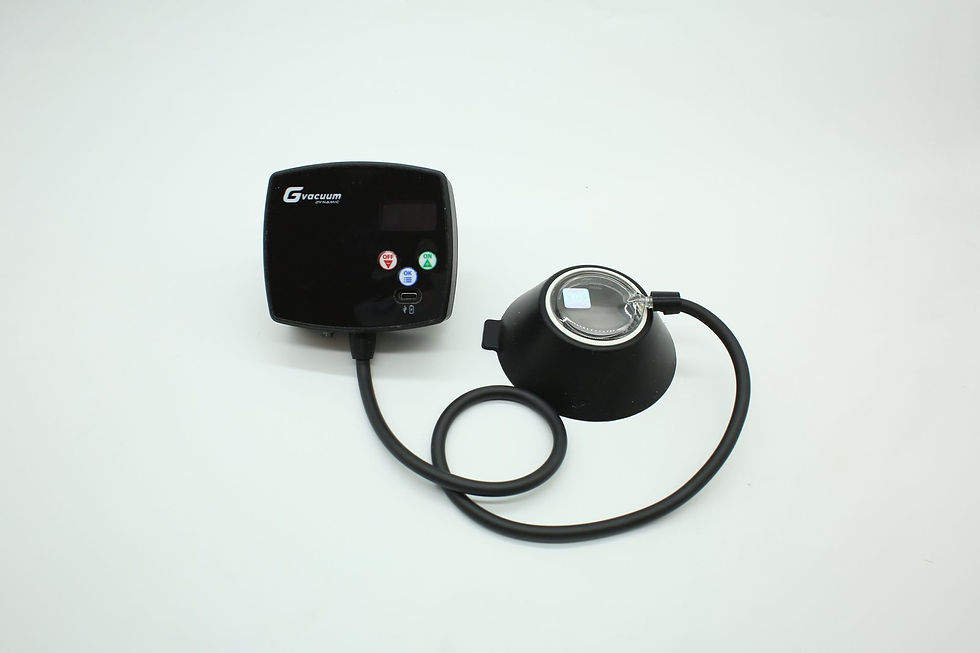
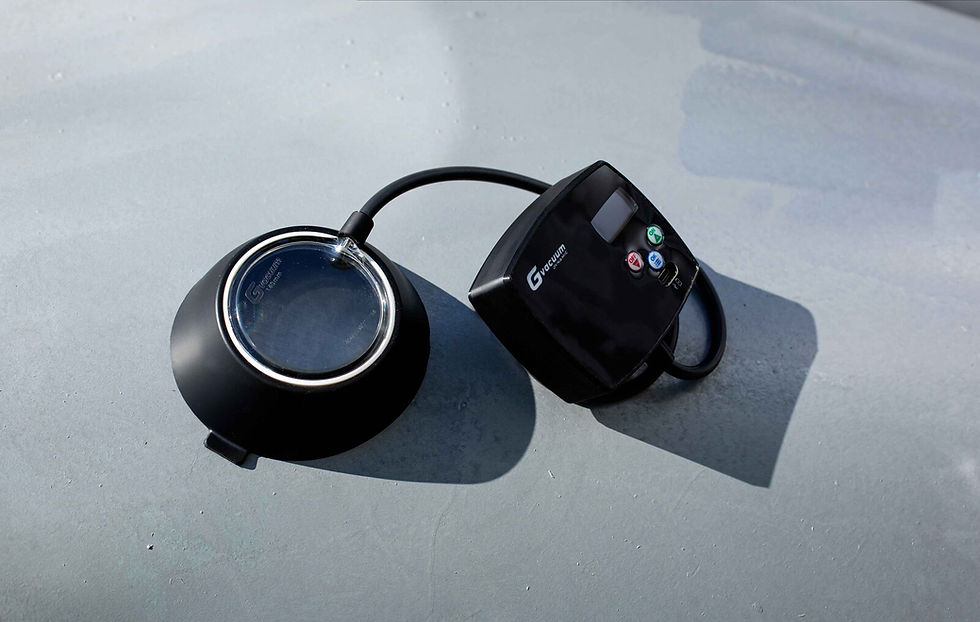
Gvacuum Dynamic Lite was developed around pressure control as its core idea: three buttons on the control unit (plus, minus, and menu) let the user choose among 10 pressure steps, so it's never "all or nothing" — there's a graded range of options instead. The digital display shows real-time pressure and session time, and the device works to hold the selected level throughout the session rather than letting pressure drift on its own.
Different vacuum bell presets let the user tailor a session to their own anatomy and needs, and the Quick Start feature means every session can begin from a pre-set starting point rather than from scratch. What these features share is that control over pressure and duration stays with the user (and with family or a specialist, when needed) rather than with the device — which lines up with the "graded, trackable pressure" principle the literature emphasizes [1][2].
A digital display and target-pressure holding aren't cosmetic extras — they directly affect day-to-day adherence to treatment. When a user can see exactly what pressure they're at during a session, they feel more confident keeping every day's session within the same safe range, which is a practical factor that supports consistency over the course of a long-term treatment.
5. Questions Worth Asking Before You Buy
When you come across a product marketed as an "electronic pump," it's worth asking a few concrete questions before looking at the price tag. Does the device have a pressure setting, and if so, how many steps; is the applied pressure shown on a display, or is the user just guessing "how hard it's pulling"; can the device hold a given pressure level, or does it need to be checked and adjusted by hand constantly — these three questions alone go a long way toward showing whether a product is "controlled" or "featureless."
The other important questions are about who the product is actually made for: was the device designed with child or adolescent users in mind, or is it a general-purpose product; does the manufacturer provide a clear usage guide and support specific to pectus treatment; is there a technical or specialist support line you can reach if something goes wrong? If you can't get clear, concrete answers to these questions, it's worth considering that the product may have been designed as a general-purpose pump rather than for treatment.
Finally, it's worth asking about the product's origin and after-sale support: who makes the device, and do they have a track record in medical devices; how is the warranty handled, and is there support for spare parts (hose, vacuum bell, pump, and so on); is it clear who you'd contact if the device fails or something unexpected happens? Vague or evasive answers to these questions can be a sign that the product was designed for a one-time sale rather than long-term treatment use.
6. Is There Clinical Research on This?
There are peer-reviewed systematic reviews and published clinical experience on the overall safety and effectiveness of vacuum bell therapy, and on why controlled, graded pressure matters [1][2][3][4]. These publications support, on scientific grounds, why measurable and trackable pressure matters for treatment safety and how it affects adherence to regular use.
To be honest, though, there is no head-to-head clinical study directly comparing specific brands — brand-specific comparative trials are rare in the medical device literature generally. What's shared here isn't a claim that one product is "scientifically proven superior" to another; it's a comparison of which design features put the literature's general "controlled pressure" principle into practice. Asking whether a product is backed by clinical literature is itself one of the questions worth asking before you buy.
When buying a medical product, price shouldn't be your only decision criterion. Understanding a product's features well, honestly assessing whether it will actually help you, and getting clear answers to the questions above matter far more in the long run — both for the safety of your treatment and for the outcome you get — than price does.
Sources
1. Schier F, Bahr M, Klobe E. "The vacuum chest wall lifter: an innovative, nonsurgical addition to the management of pectus excavatum." Journal of Pediatric Surgery. 2005;40(3):496-500. pubmed.ncbi.nlm.nih.gov/15793724
2. Haecker FM, Mayr J. "The vacuum bell for treatment of pectus excavatum: an alternative to surgical correction?" European Journal of Cardio-Thoracic Surgery. 2006;29(4):557-561. academic.oup.com/ejcts/article/29/4/557/478894
3. Obermeyer RJ, Cohen NS, Jaroszewski DE. "The vacuum bell for conservative treatment of pectus excavatum: the Gundersen Health System experience." Journal of Visualized Surgery. 2016;2:181. www.ncbi.nlm.nih.gov/pmc/articles/PMC5783241
4. Kumar B, et al. "Vacuum bell therapy for pectus excavatum: a systematic review." Journal of Indian Association of Pediatric Surgeons. 2026. www.ncbi.nlm.nih.gov/pmc/articles/PMC13127786
Contact Us
Have questions? Talk to our team about pectus treatment products and the right solution for you.