What Sets Gvacuum Dynamic Lite Apart From Other Vacuum Bell Devices
Why Vacuum Bell Devices Aren't All the Same
Vacuum bell therapy for pectus excavatum works by applying controlled negative pressure to the chest wall, gradually lifting it over time. Foundational studies describe this conservative approach as an alternative, or a pre-surgical option, for patients whose chest wall is still flexible during growth [1]. The method itself has barely changed in decades: pump by hand until you reach the target pressure. Literature also shows that daily adherence (compliance) is one of the most decisive variables for clinical outcome [2]. Gvacuum Dynamic Lite was designed to make a difference exactly here: it adds a digital layer to that same core method, with a live pressure and time display, target-pressure maintenance, multiple working modes, and a simple three-button interface that helps users repeat the same session, with the same ease, every single day.
Patients often ask what actually makes Dynamic Lite different. This article walks through its standout features one by one.
A Live Display Instead of Guesswork
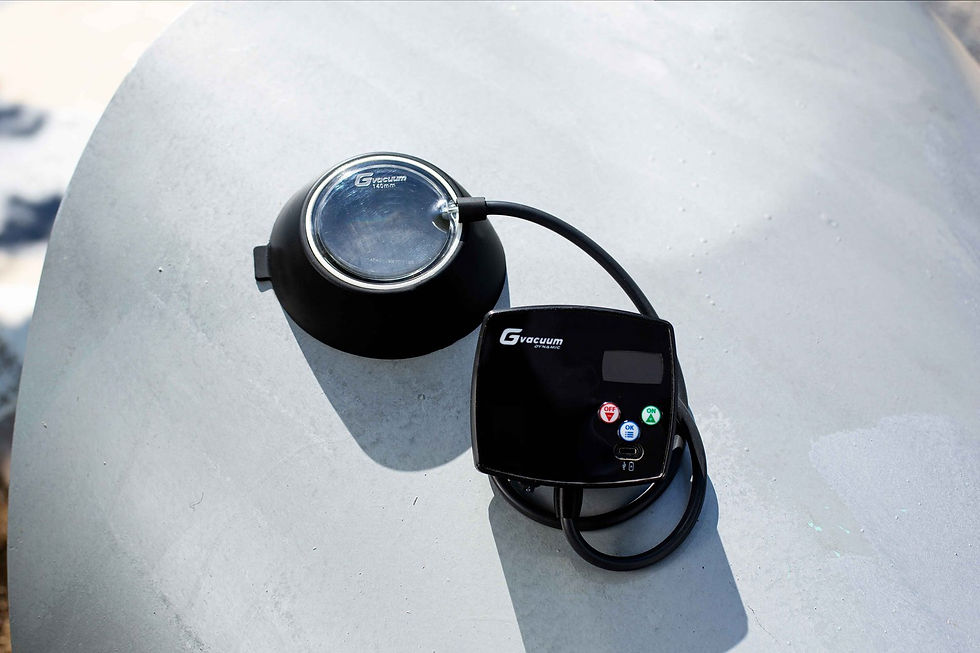
On a classic, hand-pump-only vacuum bell, the user has no gauge to read - they rely on feel and elapsed time. Gvacuum Dynamic Lite's control unit shows the applied pressure and elapsed time live on screen, accessible through a simple three-button (plus, minus, menu) interface. That means the question "did I reach the right pressure, how long has this session run" is answered by the screen, not by guesswork. This is especially valuable in the first weeks of treatment, giving the user - or a parent tracking a child's session - a concrete reference point to feel confident about.
Target-Pressure Maintenance Keeps the Session on Track
Pressure can drift downward during a session as the vacuum bell's seal against the skin loosens slightly with small movements. Gvacuum Dynamic Lite's target-pressure maintenance feature automatically monitors the set pressure throughout the session and pulls it back up if it detects a drop. This lets the user keep watching TV, doing homework, or simply relaxing, without constantly checking whether the pressure has quietly dropped.
More Than One Way to Run a Session
Many vacuum bell models offer exactly one way to operate: pump, reach the target, track the time yourself. Dynamic Lite's control unit supports several working modes instead - manual on-the-fly adjustment, presets that recall a saved configuration in one step, and a custom setting the user can define themselves. This lets the same device adapt to different stages of treatment: a new user can start by adjusting step by step, while an established user can recall a saved configuration instantly on a busy morning.
A Simple Three-Button Interface
Too many digital features can make a device harder to use; Dynamic Lite's interface was deliberately kept simple. The control unit is operated with just three buttons (plus, minus, menu), so switching between modes or reading the screen never requires a steep learning curve - a real advantage for growing children and for families making the device part of a daily routine.
How These Features Work Together, Day to Day
On their own, these features sound technical; in daily use, they work as a team. The user starts the morning session by calling up a saved preset; target-pressure maintenance keeps the pressure steady while the live display shows exactly where things stand. Literature consistently shows that daily consistency is what ultimately drives outcome [1][2]; Dynamic Lite's features exist to make that consistency easier to sustain.
Frequently Asked Questions
What is Dynamic Lite's single biggest advantage?
Being able to track pressure and time live, keep pressure automatically at target, and switch between several working modes as needed.
Does the digital display shorten treatment?
No. The display doesn't change the treatment itself; it gives the user an easier way to track the session and stay consistent with the pressure plan.
Does target-pressure maintenance mean I don't need to pay attention at all?
It significantly reduces the burden of correcting small pressure drops yourself, but skin and overall session monitoring remain the user's responsibility.
Who decides which working mode (manual, preset, custom) to use?
That choice should follow the treatment stage and the plan set by the clinician; there's no single ranking that fits every patient.
Closing
What sets Gvacuum Dynamic Lite apart from other vacuum bell devices comes down to a live pressure and time display, target-pressure maintenance, multiple working modes, and a simple three-button interface. Together, these features lower the day-to-day effort of treatment and support the daily consistency that the literature identifies as the real driver of outcome [1][2]. Which mode and settings suit a given patient should always be decided together with the clinician managing the treatment.
Sources
1. Haecker FM, Mayr J. "The vacuum bell for treatment of pectus excavatum: an alternative to surgical correction?" European Journal of Cardio-Thoracic Surgery. 2006;29(4):557-561. academic.oup.com/ejcts/article/29/4/557/478894
2. Koo DC, et al. "Optimizing Efficacy of Vacuum Bell Therapy for Pectus Excavatum: Compliance is Key." Journal of Surgical Research. 2025. pubmed.ncbi.nlm.nih.gov/40088797
Sources
Contact Us
Have questions? Talk to our team about pectus treatment products and the right solution for you.