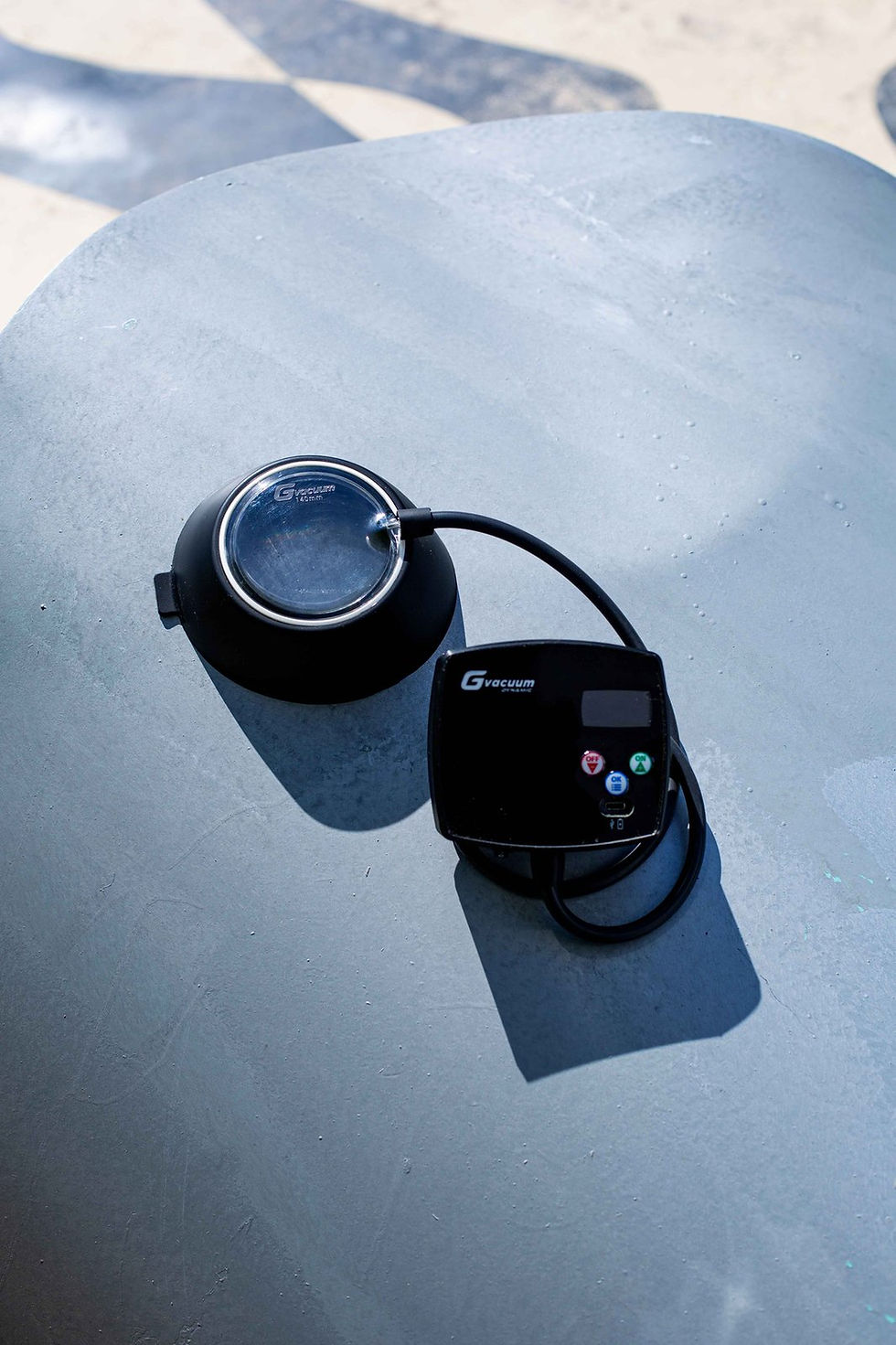
What Happens If Your Vacuum Bell Pump or Hose Breaks Mid-Treatment?
Vacuum bell therapy for pectus excavatum (sometimes called a sunken or funnel chest) uses controlled negative pressure applied to the chest wall to gradually reshape the cartilage and bone over months. [1] It isn't a single procedure - it's a daily, long-term routine guided by a plan the clinician sets.
That long duration turns treatment from a simple device choice into a question of continuity. A recurring finding in the literature is that outcomes in vacuum bell therapy depend heavily on daily, consistent use of the device. [2] That principle is tied not just to patient habit, but to how reliably the device itself holds up to daily use.
This article looks at how the mechanical components of a vacuum bell - the pump and the hose - wear over time, how that wear can affect treatment continuity, and how Gvacuum's spare-parts and warranty approach addresses it, without making any success-rate or outcome-guarantee claims.
Why the Pump and Hose Matter Over Months of Daily Use
Two components generate and hold the pressure in a vacuum bell system: the hand-operated silicone pump, and the hose connecting it to the bell itself. Over the course of treatment, these are the parts used once or several times a day, every day, for months.
Like any mechanical part, repeated squeezing and flexing can lead to material fatigue over time. Features referenced in Gvacuum's product materials - an airlock mechanism, an angled inlet, a reinforced hose, and a thicker-walled pump - are engineering details aimed at improving durability under that kind of repeated use. It's worth being clear that this describes an engineering approach, not a specific durability timeline or a guarantee.
The bell itself is described in Gvacuum's materials as being made from medical-grade silicone, chosen for its combination of flexibility and durability against repeated compression. The seal between the bell and the skin depends on that silicone staying supple - a seal that has hardened or cracked over time can leak air just as easily as a worn pump or hose can, which is another reason the condition of every component, not just the two moving parts, is worth keeping an eye on during a long treatment course.
What Happens When a Component Fails Without a Backup
A problem with the pump or hose - an air leak, a loosened connection, a crack in the material - can make it harder to hold pressure at the planned level. Without a spare part on hand, that can mean skipping or delaying that day's session.
Because continuity is a variable the literature keeps pointing to [2][3], a single unplanned gap may look minor on its own, but repeated interruptions can disrupt the daily rhythm the treatment depends on. In younger patients especially, a device that "isn't working" can also dent motivation to keep going.
Gvacuum's Spare-Parts and Warranty Approach
According to current product information, the Gvacuum vacuum bell is supplied with a spare pump, a spare hose, a carrying case, and a wooden depth ruler. The intent behind this is straightforward: if a part fails, the patient or family isn't left waiting on a new order before treatment can continue.
The product is also offered with a two-year warranty. To be clear: this describes a commercial policy around manufacturing standard and after-sales support - it is not a treatment-outcome guarantee or a success-rate claim. For the exact warranty terms and exclusions, current official product documentation and after-sales guidance should be consulted.
What to Check When Evaluating a Vacuum Bell
Practical questions worth asking when evaluating a vacuum bell include: does the box include a spare pump or hose, is the product covered by a warranty and for how long, how do you reach support if a part fails, and does the device come in size variants (Gvacuum references seven anatomical sizes) that fit different patient anatomies.
These questions shift the purchasing decision away from price or appearance alone, toward whether the treatment can realistically be sustained, uninterrupted, for months. Asking about the manufacturer's service process upfront can head off a lot of surprises later in treatment.
Frequently Asked Questions
What happens if my vacuum bell's pump or hose breaks?
Having a spare pump and hose in the box can make it easier to keep going without a break in treatment. Depending on the nature of the fault, it's still worth contacting the clinician or after-sales support.
Does the 2-year warranty guarantee the treatment will work?
No. The warranty is a commercial assurance tied to manufacturing standards and potential defects - not a guarantee of treatment outcome or success rate. How treatment progresses depends on the clinician's plan and consistent daily use.
How many hours a day, and for how long, does vacuum bell treatment typically require?
Daily wear time and total treatment duration depend on the patient's age, the severity of the deformity, and the plan set by the clinician - so the exact schedule should always be worked out with the treating clinician.
Do the spare pump and hose need to be replaced on a fixed schedule?
Not necessarily. They're meant as a backup for when something goes wrong, not as parts that must be swapped on a set timetable. That said, checking the pump and hose periodically for wear - cracks, stiffness, or a weaker seal - is a reasonable habit alongside regular clinical check-ins.
Conclusion
Gvacuum's product approach factors in the long, repetitive nature of vacuum bell treatment; the spare pump, spare hose, and two-year warranty are presented as elements meant to support that continuity, not as promises about treatment outcome.
Ultimately, evaluating a vacuum bell means looking beyond initial quality to how well-prepared the product is for the day-to-day wear and tear of months of use. Spare parts and warranty coverage are supporting factors - the real determinant of treatment progress remains the clinician's plan and how consistently it's followed.
Sources
[2] Obermeyer RJ. Incorporating vacuum bell therapy into pectus excavatum treatment. J Vis Surg. 2016.
Contact Us
Have questions? Talk to our team about pectus treatment products and the right solution for you.