How Is Pectus Excavatum Severity Measured? Haller Index and Other Clinical Tools Explained
Pectus excavatum, sometimes called sunken chest, is a structural chest wall condition where the breastbone and rib cartilage curve inward. Because the appearance and depth of the sinking vary so much from person to person, doctors rely on standardized ways of measuring severity so that treatment decisions are consistent rather than a matter of personal impression.
This article walks through the severity-assessment methods most commonly described in the medical literature, from physical examination to imaging-based indexes. Everything here is general information drawn from published sources; it does not reflect any specific patient's data, and an individual diagnosis or severity assessment always has to come from a qualified clinician.
Severity measures are typically repeated over time, especially during growth, to track how a deformity is progressing.
Measuring severity is not only about answering "how deep is it" - it also feeds into decisions about whether surgery may be needed, whether non-surgical treatment is a reasonable option, and how often follow-up should happen over time.
Why Severity Assessment Matters
Measuring pectus excavatum severity in a standardized way lets clinicians in different centers arrive at comparable conclusions for the same patient. Without a shared measurement, words like "mild," "moderate," or "severe" can mean different things depending on who is describing them.
Severity measures are also not meant to be a single snapshot taken once. They are typically repeated over time, which lets a clinician track whether the deformity is progressing or whether a treatment is producing a measurable change.
Physical Examination and Visual Assessment
The first step in most evaluations is a physical exam. The clinician looks at where the depression is deepest (usually the lower-middle part of the sternum), whether it is symmetric or shifted to one side, and whether the lower ribs flare outward [4].
The literature also describes different visual sub-types based on the shape of the depression - for example, a narrow, deep depression is treated differently from a broader, shallower one. This visual/physical step is an important starting point, but on its own it does not give a numeric severity value, which is why it is usually paired with imaging-based measures [4].
Imaging-Based Metrics: the Haller Index and the Correction Index
The most widely used numeric measure is the Haller Index: on a chest CT scan, it is calculated by dividing the widest horizontal diameter of the chest by the shortest distance between the breastbone and the spine. In a chest without any deformity, this ratio is roughly 2.5; values of 3.25 or higher are generally treated in the literature as "severe" and are commonly used as a threshold for surgical evaluation [1] [2].
A later measure, the Correction Index, expresses how far the breastbone is displaced from its expected normal position, as a percentage, and some publications have proposed it as a more consistent measure than the Haller Index; values of 28% or higher have been linked to that same 3.25 Haller Index threshold [1] [2].
Lower-Radiation Alternatives
Because CT scanning involves radiation, repeated measurements - especially in growing children - can be a legitimate concern. For that reason, the literature has also looked at radiation-free alternatives such as MRI, 3D surface scanning, and simple external measurements taken with a caliper (an external measuring device) [3].
One published study found that caliper-based external measurements correlated strongly with CT-based Haller and Correction Index values, and concluded they could be useful both for screening cases that may need surgery and for monitoring treatment over time [3]. Methods like this have the potential to reduce radiation exposure, especially for patients who need frequent follow-up visits.
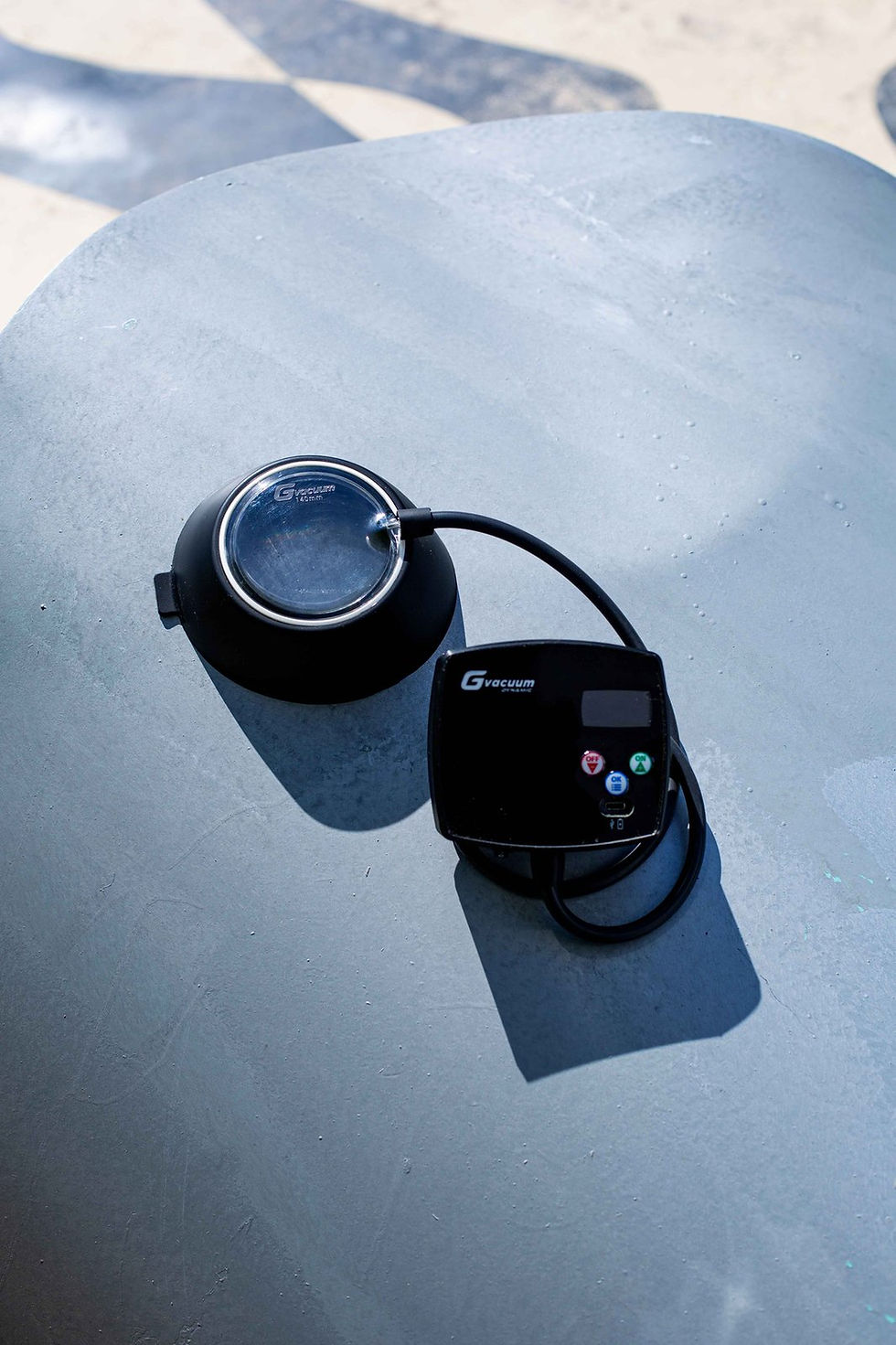
A similarly simple, non-radiation depth check is also possible during vacuum bell treatment itself: the wooden depth ruler included with some Gvacuum vacuum bell packages can be used before, during, and after treatment to get a basic reading of how deep the chest depression is. This is not a scientifically validated substitute for the Haller Index or Correction Index and has not been compared against those clinical measures in published research - but it can be a simple, practical, radiation-free way for families and clinicians to observe change over time.
How Severity Classification Shapes Treatment Decisions
When the Haller Index, the Correction Index, and physical exam findings are considered together, they give a clinician a general framework for recommending either surgical repair or non-surgical monitoring and treatment. The literature is clear, though, that a single numeric threshold does not automatically dictate a treatment decision on its own - these values are one part of a broader clinical evaluation [1] [2].
Alongside severity, the evaluation also takes into account whether symptoms are present (such as reduced exercise capacity), how much the heart and lungs are physically affected, the patient's age and growth stage, and the psychological impact the deformity's appearance may have on the patient. Severity measures are therefore one piece of evidence feeding a treatment decision, not the sole determining factor.
For this reason, a thorough evaluation often goes beyond imaging measures alone: exercise testing, pulmonary function tests, and echocardiography can help show how the chest wall depression is physically affecting the heart and lungs [5]. Whether these additional tests are needed is a decision the clinician makes case by case; they are not necessarily ordered routinely for every patient.
Practical Tips for Families
During an evaluation, useful questions families can ask a clinician include: which measure is being used (Haller Index, Correction Index, physical exam), how and how often that measurement will be repeated, and whether radiation-free alternatives (such as MRI or caliper measurement) are an option if that matters to the family.
Regular follow-up visits, and - to the extent a clinician finds it useful - simple methods like standardized photographs, can help track how severity changes over time. This helps both the family understand the process and gives a more objective picture of how the patient is responding to treatment.
Frequently Asked Questions
At what Haller Index value is pectus excavatum considered severe?
The literature reports that a chest without any deformity has a Haller Index of roughly 2.5, and that a value of 3.25 or higher is generally considered severe [1] [2]. On its own, though, this number does not determine a treatment decision - the result should always be discussed with a clinician.
At what severity level is non-surgical treatment recommended?
There is no single answer to this. Severity measures are one part of a clinician's broader evaluation, considered together with symptoms, age, and how flexible the chest wall is. What approach is appropriate is decided individually for each patient.
Is severity assessed in a single visit?
Usually not. Severity measures, especially in growing patients, are typically repeated over time to track whether the deformity is progressing and how it is responding to treatment - so follow-up frequency is also something to plan together with a clinician.
Closing Thoughts
Assessing pectus excavatum severity is a standardized process that brings together several methods, from physical examination to imaging-based Haller and Correction Index values, through to radiation-free alternatives like MRI and caliper measurement. None of these measures makes a treatment decision on its own, but together they give a clinician a reliable basis for that decision.
Pectuslab shares general information like this to help families and physicians understand this kind of evaluation process; everything described here is based on published literature and is not a substitute for an individual diagnosis or treatment recommendation.
Sources
Contact Us
Have questions? Talk to our team about pectus treatment products and the right solution for you.