At-Home Vacuum Bell Therapy: How to Build a Daily Routine with the Gvacuum Dynamic Lite
Vacuum bell therapy, used for the chest-wall deformity known as pectus excavatum or "funnel chest," is one of the most studied non-surgical approaches available today. The method relies on applying controlled negative pressure to the chest wall to temporarily lift the sternum outward; this mechanism has been repeatedly described in the literature through both imaging studies and clinical observation [1].
One finding that stands out across the literature is that treatment success is shaped not by a single session, but by months of consistent use. A recent study evaluating the effectiveness of vacuum bell therapy specifically emphasizes that frequency and duration of use — in other words, adherence (compliance) — is one of the most critical variables determining outcome [2].
A systematic review similarly shows that the safety and efficacy profile of vacuum bell therapy is closely tied to how well the patient can stick to a daily routine [3]. For this reason, how a device is integrated into daily life matters just as much as its technical specifications. In this article, we look at how to build a sustainable daily vacuum bell routine at home with the Gvacuum Dynamic Lite.
Why Daily Routine Determines Treatment Outcome
Vacuum bell therapy isn't a one-time procedure; it requires a habit repeated over weeks and months. Remodeling the chest wall's cartilage and connective tissue needs a gradual, consistent mechanical stimulus; irregular or infrequent sessions can make this process progress more slowly than expected.
That's why the question of "how much pressure to apply" matters clinically just as much as "how often and how consistently to apply it." How easily a family and patient can build a routine that fits daily life directly affects the sustainability of treatment — and therefore its long-term outcome.
This principle, which holds true across conservative treatments in general, applies to vacuum bell therapy the same way: what matters is not just the device itself, but how often and how consistently it's used. That makes daily routine not a technical detail of treatment, but an inseparable part of the treatment itself.
The chest wall being more flexible during the growth years is one reason a consistent routine established during this period is especially valuable. Given that flexibility decreases over time, establishing a consistent daily-application habit early on is considered beneficial for the treatment process as a whole.
For this reason, vacuum bell therapy is generally planned for children and adolescents during the growth years, to take advantage of the chest wall's relative flexibility; however, the exact age range and suitability are always determined by the examining physician. The daily routine is shaped around this individual plan as well; what's described here offers a general framework, not a substitute for a personalized treatment program.
How to Start the Day: Setting a Fixed Session Time
The first step in a daily routine is doing the session at the same time each day, if possible. Choosing a fixed window — for example, right after waking up or right after dinner — reduces the risk of the session being forgotten or postponed.
A fixed time makes it easier for both the patient and the family to get used to the routine. Choosing a time slot that doesn't clash with school, work, or other daily activities helps the routine stay sustainable over weeks and months; a consistent framework, rather than an arbitrary or day-to-day changing time, makes it easier to build the habit.
Gradually increasing session duration and pressure in the first few weeks can also make it easier to adjust to the routine. It's expected that the body will take time to adapt to a new application; starting with shorter, lighter sessions in the early days and progressing gradually according to the physician's recommended plan can help the routine become lasting.
How the Gvacuum Dynamic Lite Makes Daily Use Easier
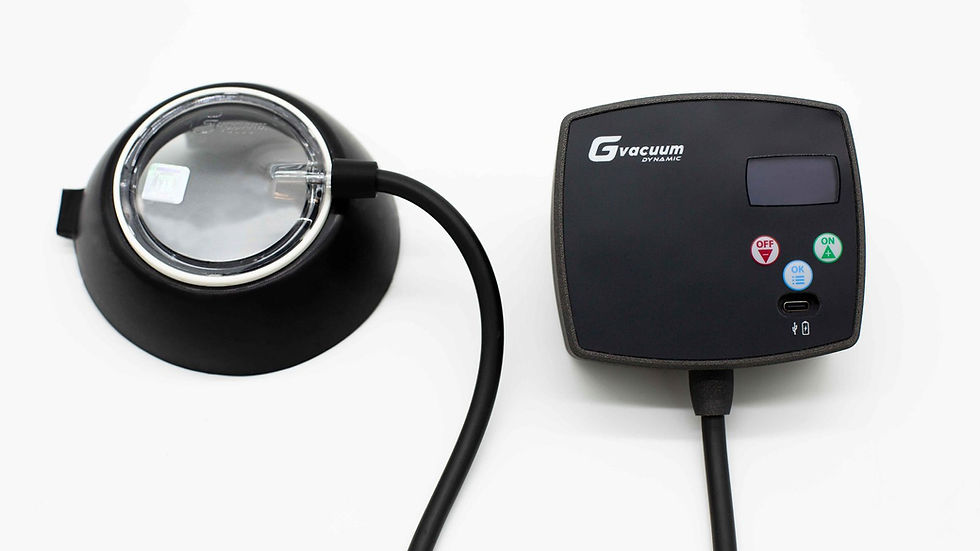
The Gvacuum Dynamic Lite is designed with a simple three-button interface to simplify daily use: plus, minus, and menu. This simple design helps the patient or family use the device without feeling overwhelmed, especially in the first weeks of treatment.
The device's Quick Start feature makes it possible to begin a session in one step with pre-set settings, which makes it easier to keep up the routine, especially in the middle of a busy day. Thanks to ten pressure levels, pressure can be gradually adjusted to the patient's comfort on any given day.
The live pressure and duration display on the screen makes what's being applied visible during the session; the mechanism aimed at maintaining target pressure also helps keep pressure steady without fluctuation throughout the session. Preset Vacuum Bell settings offer a repeatable starting point for different body shapes, so there's no need to start from scratch every session.
The device being USB-C rechargeable is also a practical detail for daily use; regularly checking the device's charge as part of a fixed routine prevents an unexpected disruption at session time.
To be clear: these features are practical tools for making the daily routine easier; they don't imply a guaranteed treatment duration or outcome. The course of treatment varies from person to person depending on the deformity's characteristics, the patient's age, and physician follow-up. More information about the Gvacuum Dynamic Lite is available on the product page.
Practical Tips for Integrating It Into Your Daily Routine
Turning the session into a natural habit — like brushing your teeth — rather than an "extra" daily obligation makes long-term adherence easier. Setting a fixed reminder on your phone, or attaching the session to an existing routine (for example, right before breakfast or right before going to sleep), is a practical starting point.
A brief skin check after the session should also be a natural part of the routine. Mild redness in the vacuum area is expected; however, if persistent or increasing discomfort is felt, it's recommended to consult the treating physician.
Among patients followed at Pectuslab's center in Kadıköy, Istanbul, a daily routine supported by regular follow-up appointments has also been observed to make treatment adherence easier. Meeting with the physician or specialist at regular intervals also offers an opportunity to readjust the routine (such as pressure or duration) when needed.
Tracking session records — date, duration, perceived pressure comfort — with a simple note or diary supports the patient's motivation and also gives the physician consistent information at follow-up appointments. These records, accumulated over time, can also make disruption points in the routine visible.
Small details — such as making sure the room isn't too cold or too hot, and choosing a calm environment free of distractions — can also contribute to a comfortable session. Especially for child and adolescent patients, having the session in a comfortable, stress-free environment can help build a positive attitude toward the routine.
Siblings or other household members being familiar with the routine can also help the session be perceived as a natural everyday activity. Especially for younger patients, seeing the treatment not as something to hide, but as an ordinary part of daily life, can support long-term adherence.
Obstacles That Make Adherence Harder, and How to Manage Them
The changing pace of daily life — school, work, or travel — can disrupt the routine. In such periods, rather than skipping the session entirely, completing it at the closest possible time or in a short, adapted duration prevents the routine from being interrupted altogether.
A drop in motivation is also common, especially in treatments that last for months. At this point, family support, setting short-term goals (such as uninterrupted sessions for a month), and making progress trackable can help maintain adherence.
The device being portable makes it possible to keep the routine going flexibly during travel or busy periods, rather than abandoning it entirely. What matters is not letting short-term disruptions turn into permanently giving up.
A Routine Built in Partnership With Family and Physician
Especially for child and adolescent patients, family plays a major role in maintaining the daily routine. Reminding the patient about the session, making sure the device is used correctly, and checking the skin together afterward help the treatment be embraced as a responsibility shared by the family, not just the patient.
Regular communication with the physician also matters for updating the routine over time. Growth, comfort level, or changes in the daily schedule may call for reassessing pressure or session frequency; these decisions should always be made together with the specialist following the treatment.
From Our Patients' Daily Routine Experience
Observations shared by our patients and their families following Gvacuum Dynamic Lite treatment during follow-up visits show how the recommendations above play out in daily life. Shared with patient privacy protected and without any identifying information, these experiences are personal; each patient's course can differ.
The family of one of our patients, who switched from the manual vacuum bell to the Gvacuum Dynamic Lite, describes their daily use at a follow-up visit like this: "We use it for a total of 3 hours a day, 1.5 hours in the morning and 1.5 hours in the evening; we're happier with this device, the pressure doesn't drop while moving around. We used to use the manual one before, which could keep releasing while moving, and we constantly had to check it by hand. Now our child has gotten used to the process and can keep track of the hours themselves."
*To watch the video behind this experience: Watch the video*
At a 14-year-old patient's third-month follow-up, the family summed up the daily routine like this: "When he puts it on in the evenings he can sit, walk, eat; no problem at all. It's only while sleeping — when he puts it on in the morning, the pressure can fluctuate a bit. With the manual model, it used to release on its own at night; with this one, there's no such release. It took a little time to get used to, but because he kept at it consistently, he really benefited."
*To watch the video behind this experience: Watch the video*
Another patient of ours, who had previously used a manual vacuum bell, describes how he integrated the Dynamic Lite into his daily life like this: "You can do it sitting down or lying down — it depends on what's comfortable. I can keep it on while studying or using the computer too. I find the digital one easier, so I haven't gone back to the manual one."
*To watch the video behind this experience: Watch the video*
These experiences confirm the principle emphasized throughout this article: what determines the course of treatment is less about the device's technical features and more about how smoothly those features can be integrated into daily routine. Each patient's course and outcome differ; treatment must always be planned individually, with expert physician assessment and follow-up.
Frequently Asked Questions
How long should a daily session last?
Session duration and frequency vary depending on the patient's age, the characteristics of the deformity, and the plan set by the physician; rather than giving a general duration, it's recommended to stick to the program recommended by the treating physician.
If a day of the routine is missed, does treatment have to start over?
No; after a missed day, the routine can continue where it left off. What matters is not letting short-term disruptions turn into long-term abandonment.
Do you need to use the Gvacuum Dynamic Lite more than once a day?
This depends on the treatment plan set by the physician; a single daily session is enough for some patients, while different frequencies may be recommended in other plans. The final decision always belongs to the specialist following the treatment.
Closing
In vacuum bell therapy, daily routine is just as decisive a factor as pressure settings, and the literature repeatedly shows this relationship [2][3]. The Gvacuum Dynamic Lite's simple interface and features like Quick Start offer practical tools that make it easier to fit this routine into daily life; however, the course of treatment should always be evaluated together with physician follow-up.
Sources
Contact Us
Have questions? Talk to our team about pectus treatment products and the right solution for you.