Text Neck and Poor Posture: When Exercise Is Enough and When Support Is Needed
"Text neck" is not a medical diagnosis; it is the name of a common observation. The posture in which the head drops in front of the shoulders, the chin pushes forward and the shoulders roll inward is known in the literature as forward head posture, and it is seen in almost every age group at varying degrees. Screens are widely assumed to trigger it, yet a 2024 systematic review notes that the studies examining the link between screen use and head-neck posture in adolescents are few and methodologically limited, and that firm conclusions need more research.
The link with pain is not as straightforward as it seems either. A 2019 meta-analysis pooling fifteen studies found a significant association between forward head posture and the intensity of neck pain in adults, but no such association in adolescents, and stressed that age is a decisive factor. In other words, text neck in a teenager usually does not hurt yet; the real question is whether the posture will become permanent.
The good news is that exercise works in this picture. A 2018 meta-analysis of randomised controlled trials showed that corrective exercise improves the head-neck angle with strong evidence and reduces pain moderately; another meta-analysis published in 2024 reported that strengthening and stretching programmes improve forward head, rounded shoulder and upper-back kyphosis angles together. This article explains what text neck is, how to spot it at home, when exercise is enough and when brace support comes into play, in the light of that literature.
What is text neck, and what happens in the body?
The further the head drifts forward, the heavier the load on the neck muscles. When the head sits directly over the shoulders, the neck muscles balance it almost effortlessly; with every centimetre it moves forward, leverage forces those muscles to carry a larger load continuously. Hours spent over a phone, tablet or laptop keep the head in that forward-tilted position for long stretches, tiring the muscles at the back of the neck and letting the deep muscles at the front go slack.
Over time a pattern of muscle imbalance sets in. The chest muscles and the upper-back-of-neck muscles shorten and tighten, while the back muscles that pull the shoulder blades back and the deep front-of-neck muscles weaken. In the literature this pattern is called upper crossed syndrome, and three things appear together: forward head, rounded (inward-turned) shoulders and increased rounding of the upper back.
The critical point is that the picture is functional. When the person pays attention, is reminded, or the muscles are rebalanced through exercise, the posture corrects; there is no change in the shape of the vertebrae. The problem is when this posture persists for months or years during a period such as adolescence, when the spine is still taking shape. SOSORT's consensus paper on kyphosis points out that postural kyphosis can become structural during growth, and that is the central distinction of this article.
Signs and a simple check at home
Text neck is usually spotted in a photo before it is felt as pain. Signs to watch for:
In a side-on photo, the ear canal sits clearly in front of the tip of the shoulder
The chin juts forward, the shoulders turn inward, the upper back rounds
Pain and tightness at the back of the neck, between the shoulder blades or at the back of the head after long screen use
Reduced neck range of motion; leaning the head back becomes harder
Neck fatigue that builds through the day rather than being present on waking
The wall test works here too. With heels, buttocks and upper back against the wall, if the back of the head does not touch the wall without effort, or the chin has to lift to make contact, the head has drifted forward. Repeating the test weekly under the same conditions is a practical way to track whether exercise is working.
The forward bend test should not be skipped either. In a teenager thought to have text neck, if one side of the back looks higher than the other when bending forward, the picture may not be purely postural and a scoliosis assessment is needed. These checks are for guidance, not diagnosis; if a sign appears, the right step is to see a specialist in spinal health (physical medicine and rehabilitation, orthopaedics or paediatric orthopaedics, for example).
When is exercise enough?
In functional text neck, exercise is the first and usually the only treatment. The 2018 meta-analysis found, across seven randomised trials, that corrective exercise clearly improved the head-neck angle and reduced neck pain; the 2024 meta-analysis reported that the best results came from programmes combining strengthening, stretching and shoulder-girdle work. The evidence favours a balanced programme over any single exercise.
A programme that works has three components:
Stretching the shortened muscles: the chest muscles and the upper back of the neck
Strengthening the weakened muscles: the back muscles that pull the shoulder blades back and down, and the deep front-of-neck muscles (the chin-tuck movement)
Changing the habit: bringing the screen to eye level, taking a short break every 30-40 minutes, holding the phone at chest height rather than in the lap
The signs that exercise is enough are clear. If the head reaches the wall more easily within a few weeks, the ear moves back toward the shoulder in the side photo, and end-of-day neck fatigue eases, the programme is working. These changes usually need 8-12 weeks of regular work to settle; expecting results in days leads to disappointment.
For most teenagers and adults the story ends here. A functional posture problem is brought under control with regular exercise and a sensible screen set-up; no brace is needed.
When is support needed?
Support is not a replacement for exercise; it comes in when exercise cannot be carried through the day. Some people exercise regularly yet slip back into the same posture for hours during lessons, exams or desk work; the muscle has learned, but the learning is not applied all day. A reminding, supportive brace carries what the muscle has learned into the day. The aim here is not correction but a reminder of correct alignment.
The decisive sign is the picture ceasing to be functional. If any of the following applies, text neck is no longer just a matter of habit and a specialist assessment is needed:
The rounding of the upper back does not correct even when the teenager tries to stand straight (suspected structural kyphosis)
One side of the back looks higher in the forward bend test (suspected scoliosis)
No measurable change after three months of regular exercise
In a growing child, posture is visibly worsening over months
Neck or back pain has begun to affect daily life, sleep or school
The brace decision rests on measurement. The 2016 SOSORT guidelines base treatment choice for spinal curves during growth on the type and degree of the curve and the growth remaining; the kyphosis consensus paper likewise recommends combining a brace with physiotherapy in structural kyphosis during adolescence. So if text neck has evolved into a structural kyphosis over time, the decision now depends on the angle measured on an X-ray and growth status, and it is made by the treating specialist.
Where does a dynamic brace fit in this picture?
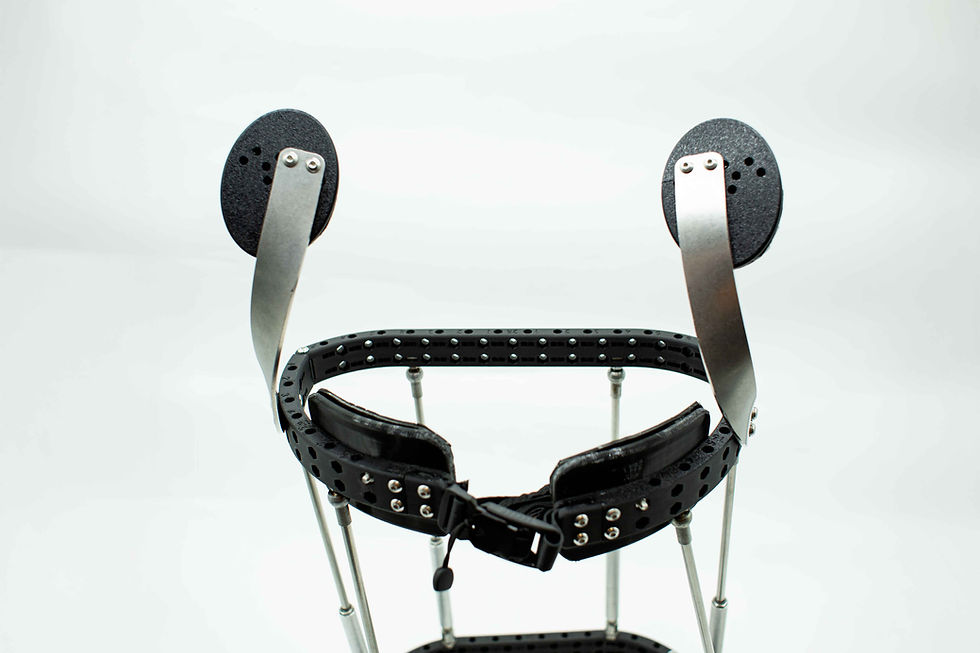
In text neck, the role of a brace is to remind, not to correct. Rigid trunk braces are designed for structural curves; in a functional posture problem a rigid shell is both unnecessary and, because it restricts movement, unlikely to be worn for long. When support is needed, what is wanted is a structure that gently reminds the shoulders back and down without restricting breathing or movement.

Yuxel is the dynamic brace developed in Pectuslab's spine line. Its open, adjustable frame does not wrap the trunk all the way round; because the pressure points can be adjusted, the same brace can be used supportively in postural kyphosis and posture problems, and correctively under specialist supervision in structural kyphosis and scoliosis. It is made in Türkiye with the brace design and manufacturing experience Pectuslab has built in chest-wall deformities.
Wear time and suitability always rest with the treating specialist. In a functional picture such as text neck, support is usually limited to lesson or desk hours and runs alongside exercise; the aim is for the muscles to become able to hold correct posture on their own, so that the brace gradually becomes unnecessary. We prefer to be open about clinical data: dynamic braces are observed to improve compliance and comfort, while controlled studies measuring long-term effect are still at an early stage. We will share the results of the studies we are running with university hospitals here as they emerge.
Frequently asked questions
Does text neck become permanent? Not while it is functional; it corrects with exercise and changes in habit. If it persists for years during growth it can affect the shape of the spine, which is why follow-up matters in teenagers.
My neck doesn't hurt. Should I still do something about it? Forward head posture in teenagers usually does not hurt yet; in adulthood its link with pain is clearer. Starting exercise before pain appears means intervening at the easiest stage.
Do I have to give up screens altogether? No. Bringing the screen to eye level, taking regular breaks and a balanced exercise programme are more effective than cutting screen time.
Does a support brace make the muscles lazy? Used alongside exercise and under specialist supervision, this concern largely falls away; support is considered next to exercise, never instead of it.
Does the same approach apply to adults? Yes, exercise and ergonomics come first; since no structural change is expected in adults, a brace is considered only for pain control and daytime support, for a limited period.
In short: text neck is overwhelmingly a functional problem solved by exercise; support comes in when exercise cannot be carried through the day, and on a specialist's decision. What matters is telling a functional picture from a structural one in time.
This article is for general information and does not replace medical diagnosis or treatment. Always decide on brace use together with your treating specialist.
References
Can electronic screens influence head and neck posture in adolescents? A systematic review. Fisioterapia e Pesquisa. 2024;31:e23008024. scielo.br
Mahmoud NF, Hassan KA, Abdelmajeed SF, Moustafa IM, Silva AG. The Relationship Between Forward Head Posture and Neck Pain: a Systematic Review and Meta-Analysis. Curr Rev Musculoskelet Med. 2019;12(4):562-577. pmc.ncbi.nlm.nih.gov/articles/PMC6942109
Sheikhhoseini R, Shahrbanian S, Sayyadi P, O'Sullivan K. Effectiveness of Therapeutic Exercise on Forward Head Posture: A Systematic Review and Meta-analysis. J Manipulative Physiol Ther. 2018;41(6):530-539. pubmed.ncbi.nlm.nih.gov/30107937
Sepehri S, Sheikhhoseini R, Piri H, Sayyadi P. The effect of various therapeutic exercises on forward head posture, rounded shoulder, and hyperkyphosis among people with upper crossed syndrome: a systematic review and meta-analysis. BMC Musculoskelet Disord. 2024;25:105. doi.org/10.1186/s12891-024-07224-4
Negrini S, Donzelli S, Aulisa AG et al. 2016 SOSORT guidelines: orthopaedic and rehabilitation treatment of idiopathic scoliosis during growth. Scoliosis and Spinal Disorders. 2018;13:3. pmc.ncbi.nlm.nih.gov/articles/PMC5795289
de Mauroy JC, Weiss HR, Aulisa AG et al. 7th SOSORT consensus paper: conservative treatment of idiopathic & Scheuermann's kyphosis. Scoliosis. 2010;5:9. pmc.ncbi.nlm.nih.gov/articles/PMC2890418
Contact Us
Have questions? Talk to our team about spine and posture treatment products and the right solution for you.